
Charlie Child: When Does Something Disposable Become Worth Keeping?
Napkins, matchboxes, coasters and scraps of hotel paper were designed to be used and forgotten. Charlie Child turns them into reasons to remember where we were.
WORDS BY BRANDDIP · LONDON
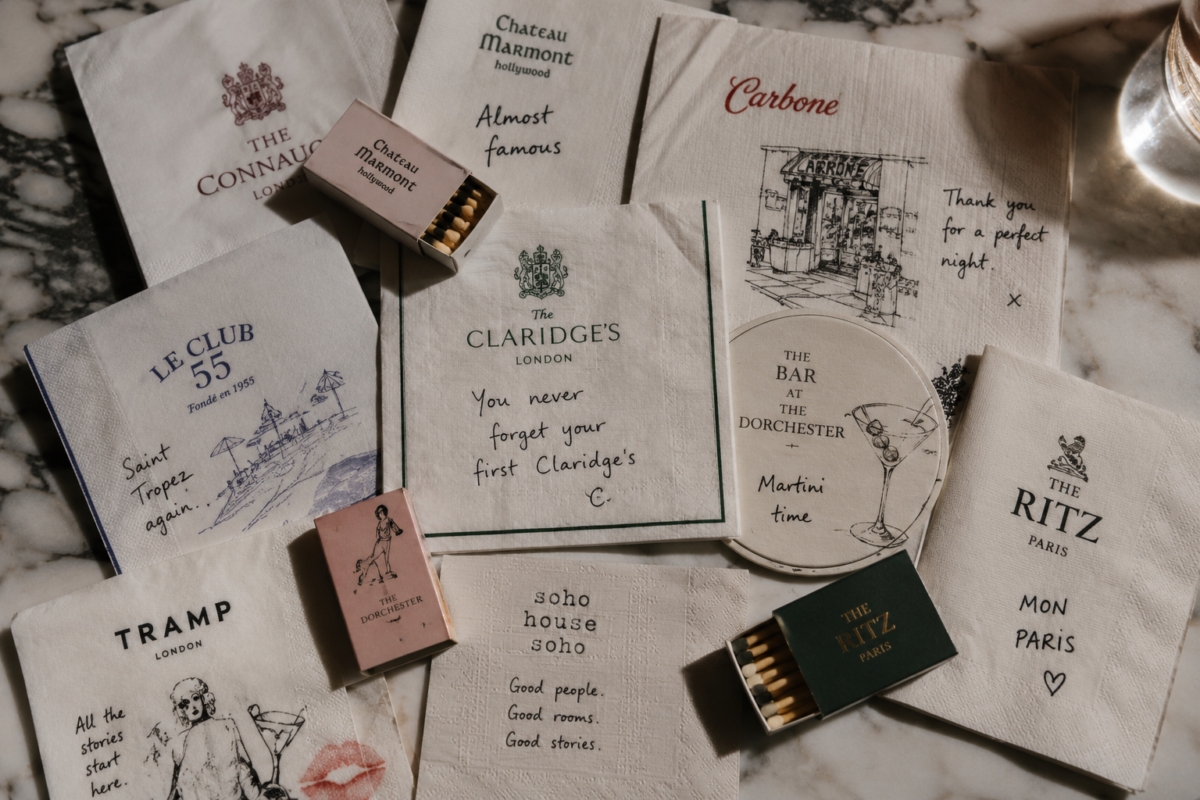
There are some things we keep without really knowing why.
A matchbox from a restaurant.
A hotel notepad with nothing important written on it.
A coaster from a bar we probably couldn’t describe accurately anymore.
Individually, they are almost worthless.
Most were designed to survive a few hours at most.
Then a place, a person or a particular night gets attached to them—and suddenly throwing them away feels strangely difficult.
Charlie Child understands that instinct.
The London-based artist and poet collects the paper traces of restaurants, hotels, clubs and bars: napkins, matchboxes, coasters, cards and other pieces of ephemera that usually disappear as quickly as the moment they belonged to.
Through his ongoing Napkin Notes series, those objects become photographic prints layered with words, drawings and small observations.
The disposable becomes permanent.
Maybe the value was never in the object.
Maybe it was in what happened around it.
We Were Never Supposed to Keep This Stuff
A restaurant napkin has a very clear job.
So does a coaster.
So does the tiny box of matches sitting beside the door of a hotel bar.
They belong to a category of design we encounter constantly but rarely think about: objects created to support an experience rather than become the experience itself.
The logo matters.
The typography matters.
The weight of the paper matters.
But only for a moment.
Then we leave.
The table is cleared. The room resets. Someone else sits down.
Charlie Child interrupts that cycle.
His Napkin Notes works begin with real objects collected from places around the world. The resulting pieces preserve the recognizable identity of those restaurants, hotels and clubs while adding another layer: something personal, funny, romantic or slightly absurd. :contentReference[oaicite:1]{index=1}
Suddenly, what was designed to disappear starts behaving like an archive.
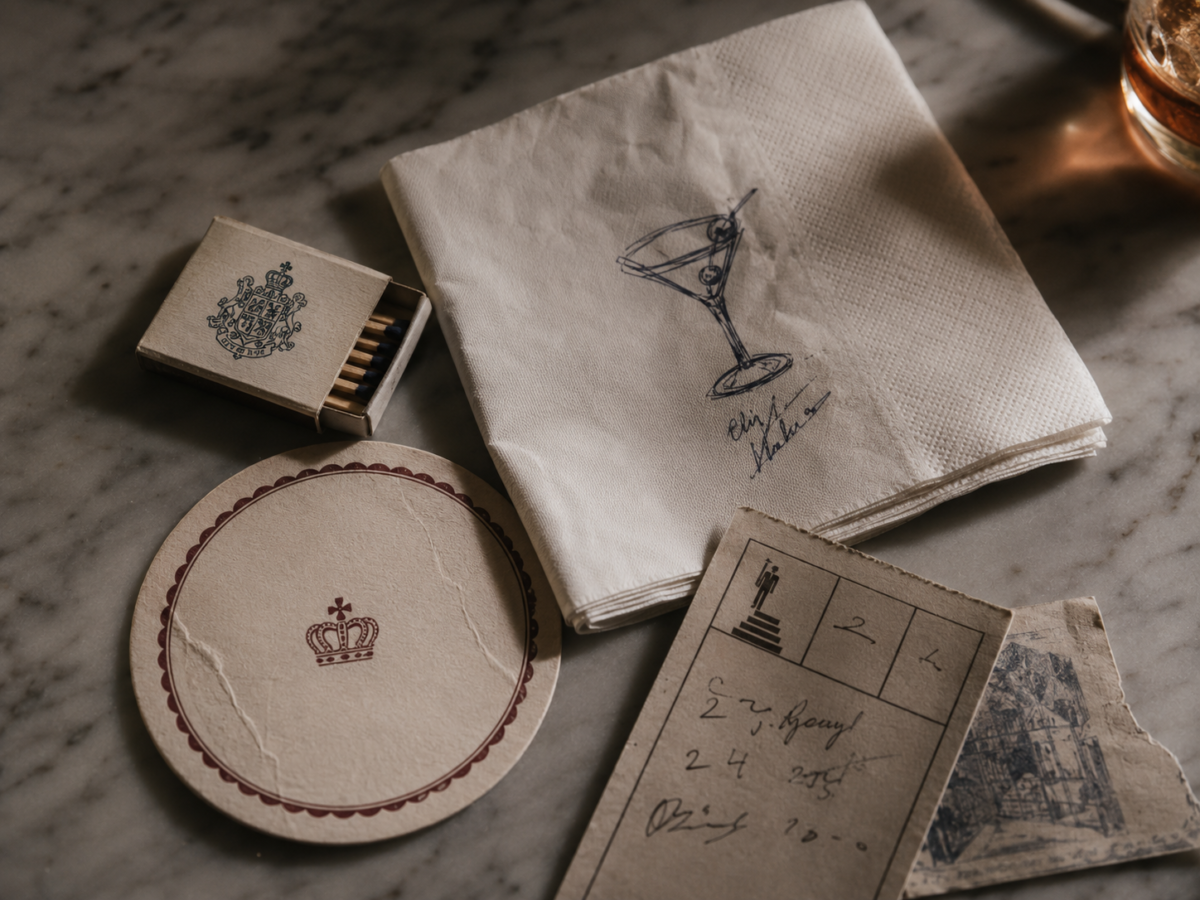
A Place Can Fit Inside a Matchbox
Luxury hospitality spends enormous amounts of effort creating atmosphere.
The lighting.
The flowers.
The glassware.
The music at exactly the right volume.
The person who somehow remembers your name.
But memory is rarely that organized.
Years later, the thing that brings an evening back might be something much smaller.
A red logo on a matchbox.
The typeface printed on a coaster.
A folded piece of hotel stationery.
Charlie’s work is interesting because it understands how disproportionately powerful these tiny objects can become.
A matchbox from the Chateau Marmont isn’t the Chateau Marmont.
A card from Le Club 55 isn’t a summer in Saint-Tropez.
A notepad from Claridge’s isn’t a night in London.
But they can be enough to unlock the rest.
His current catalogue moves through precisely these kinds of places—from Claridge’s and The Connaught to Soho Farmhouse, Ritz Paris, Carbone and Le Club 55. :contentReference[oaicite:2]{index=2}
The smallest souvenir can hold a surprisingly large memory.
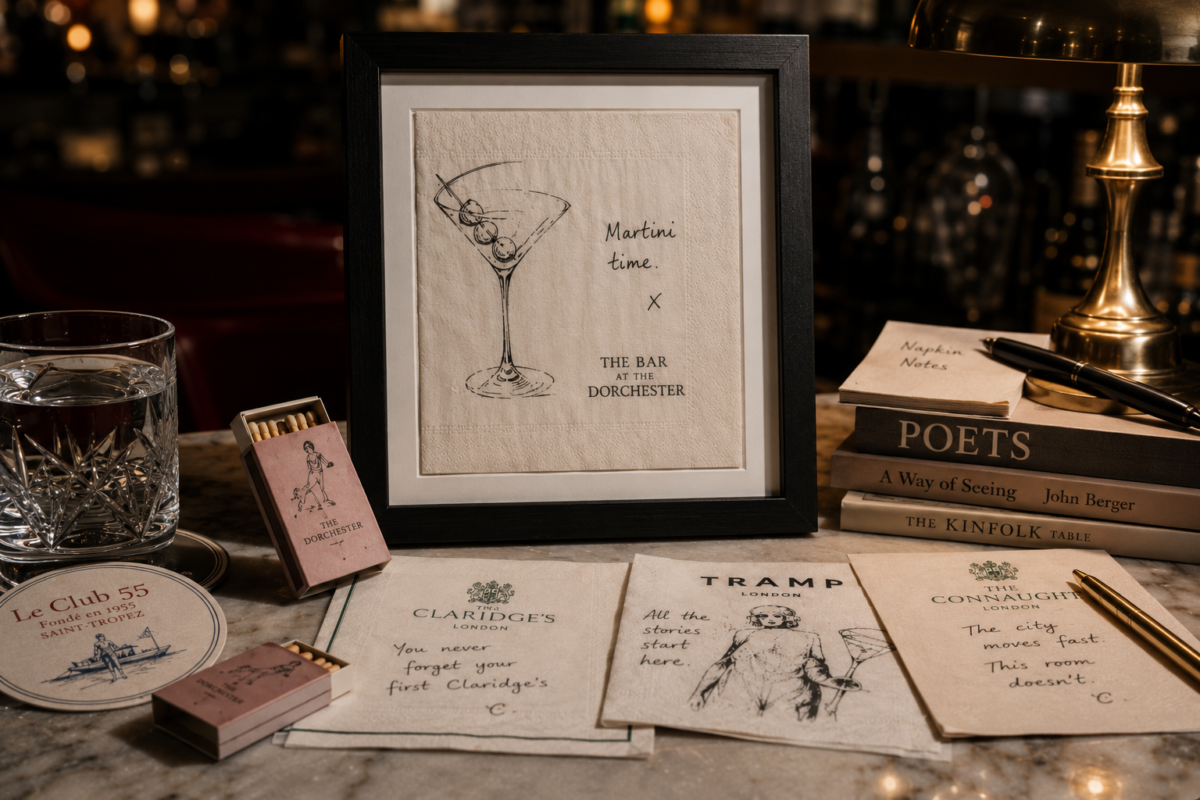
Not Everything Worth Framing Started as Art
There is something almost backwards about turning a disposable object into something designed to hang on a wall.
That contradiction is what makes it work.
A museum print begins with something already accepted as art.
A Charlie Child piece may begin with something someone nearly used to wipe the table.
The hierarchy gets confused.
What deserves to be preserved?
What deserves a frame?
Who decides when an everyday object becomes culturally valuable?
Charlie doesn’t simply enlarge branded ephemera and call it important.
His wider fine-art practice uses mixed media including acrylic, foil and oil pastel across photographic prints, linen and cotton. In the photographic works, words and illustrations sit physically over the image, giving each piece additional texture and variation. :contentReference[oaicite:3]{index=3}
That intervention matters.
The original object provides the memory.
The artist gives the memory a voice.
The result sits somewhere between souvenir, poem, design archive and artwork.
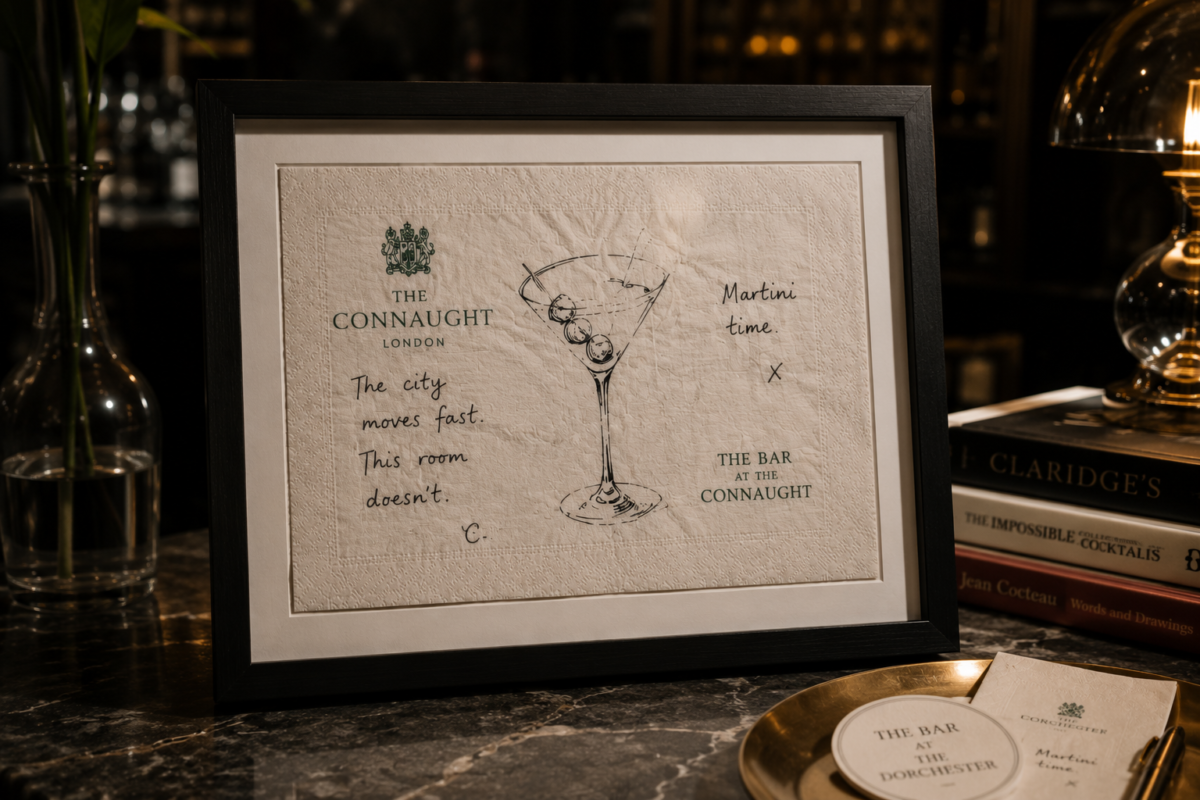
Hospitality Has Always Been About Storytelling
It makes sense that Charlie Child’s work has found such a natural home inside hotels and private clubs.
He is the first Poet in Residence at Claridge’s, and his work has been shown at places including Tramp, George, Dracula Club in St Moritz and Belmond St Moritz. He has also collaborated with names including Montblanc and Tiffany & Co. :contentReference[oaicite:4]{index=4}
These aren’t random surroundings for the work.
Hotels, restaurants and clubs already sell something difficult to package.
Not just a room.
Not just dinner.
Not just a drink.
They sell the possibility that something memorable might happen there.
Charlie Child takes the objects left around those experiences and gives them a second life.
In a strange way, his work turns hospitality branding into autobiography.
The logo remains the same.
What it means depends entirely on who was there.
Why This Feels Right Now
We have never documented more of our lives.
Every dinner can become a photo.
Every hotel room can become a story.
Every trip can become hundreds of images stored somewhere in a camera roll.
And yet physical evidence of those experiences can feel more emotionally powerful than ever.
Maybe because there is only one of it.
You can take fifty photographs of a dinner.
There was only one matchbox on your table.
A screenshot can be perfectly preserved and still feel strangely weightless.
A stained coaster can be damaged and somehow feel more valuable because it was actually there.
Charlie Child’s work lands inside that tension.
Digital life records everything. Physical objects remember differently.
They wrinkle.
They fade.
They disappear into pockets and drawers.
They acquire evidence of what happened around them.
And sometimes that imperfection is exactly what makes them worth keeping.
We don’t always keep objects because they’re valuable.
Sometimes they become valuable because we kept them.
Maybe Souvenirs Were Never About the Place
The word souvenir comes with baggage.
Magnets.
Keyrings.
T-shirts with the name of a city printed across the chest.
Things specifically designed to prove that we went somewhere.
But the objects we end up caring about most are often the ones that weren’t designed as souvenirs at all.
The receipt.
The matchbook.
The napkin.
The note written halfway through dinner.
Charlie Child makes those objects visible because he recognizes something brands sometimes forget:
people don’t remember experiences according to the hierarchy we design for them.
The expensive chair may disappear from memory.
The tiny matchbox may survive for twenty years.
That’s what makes this work particularly interesting from a branding perspective.
The most powerful piece of a brand experience isn’t necessarily the logo at the entrance or the object with the highest production budget.
Sometimes it’s the smallest thing someone decides not to throw away.
BRANDDIP TAKE
The best souvenirs aren’t always designed to be souvenirs. Sometimes they’re simply the objects that were there when something worth remembering happened.
WORDS · BRANDDIP
CATEGORY · TASTE OF BRAND
LONDON, UNITED KINGDOM