
Sinéad O’Dwyer: Why Is Seeing a Normal Body on a Runway Still Radical?
Sinéad O’Dwyer isn’t simply putting different bodies on the runway. She is asking why fashion designed the runway around one kind of body in the first place.
BRANDDIP SPECIAL · FASHION GETS PERSONAL AGAIN
PART 02 · SINÉAD O’DWYER
WORDS BY BRANDDIP · LONDON
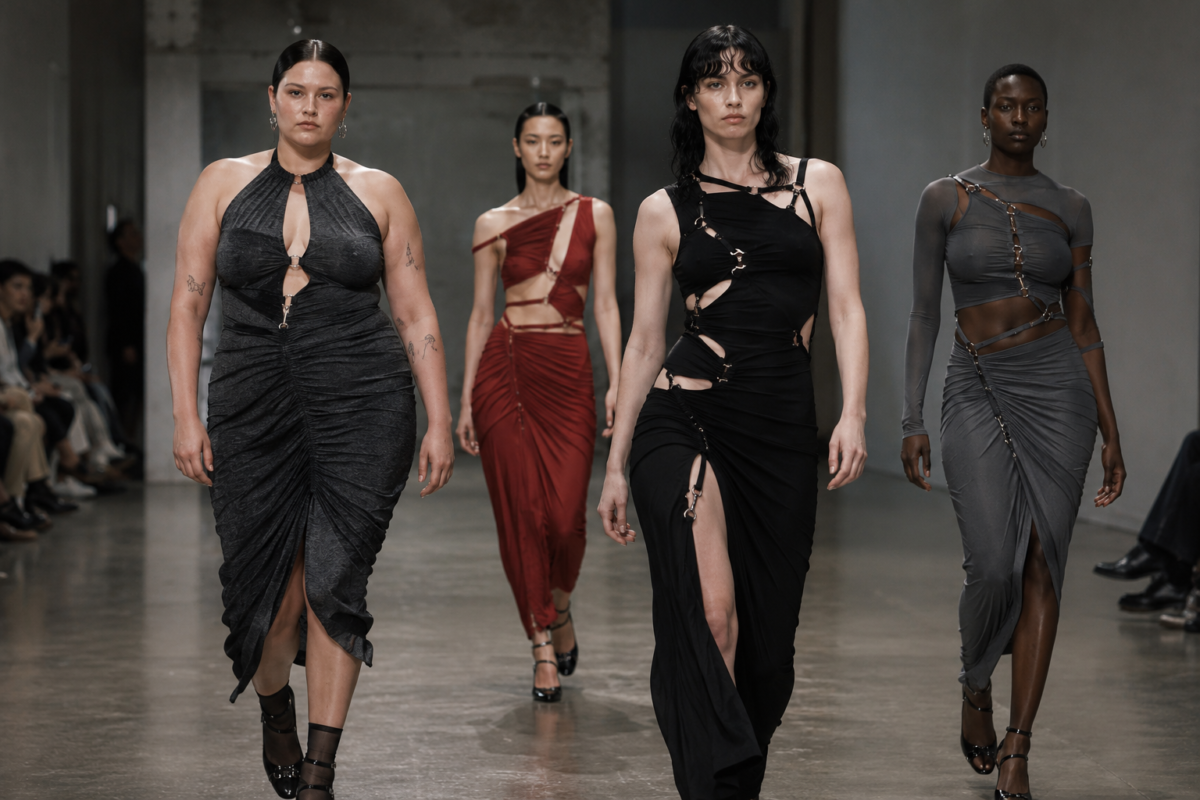
There is something strange about the phrase “real bodies.”
We use it constantly in fashion.
Real women. Real sizes. Real curves.
As if the bodies we usually see on runways belong to some other category.
The language reveals the problem before the clothes even appear.
Fashion has spent years telling us to be ourselves—to develop personal style, express individuality and wear whatever makes us feel like us.
But the body underneath those clothes has remained remarkably standardized.
Different collections. Different references. Different ideas of beauty.
Often, almost exactly the same proportions.
Sinéad O’Dwyer starts somewhere else.
She doesn’t begin by asking how more bodies can fit into fashion.
She asks what fashion might look like if it had been designed around more bodies from the beginning.
Maybe the body was never the thing that needed changing.
The Fitting Room Has Been Lying to Us
There is a small ritual that happens in fitting rooms everywhere.
A pair of trousers won’t close. A dress pulls across the chest. A sleeve feels too tight.
And almost immediately, we look in the mirror.
Maybe my waist is too wide. Maybe my chest is too big. Maybe my arms are wrong for this.
The garment stays innocent.
The body becomes the problem.
That relationship is so familiar that it barely feels unusual anymore.
But clothing isn’t found in nature.
Someone designed it.
Someone chose the measurements.
Someone decided where the waist should sit, how wide the hips should be, how much room the chest should have and what proportions would become the starting point.
Every garment contains an idea of a body.
And for a very long time, fashion kept imagining a remarkably similar one.
O’Dwyer’s work reverses the question.
Instead of asking:
How can this body fit the garment?
It asks:
How should the garment respond to this body?
One Size Doesn’t Simply Become Another
The easiest version of inclusivity is a size chart.
Add more numbers. Extend the range. Make the same dress bigger.
Problem solved.
Except bodies don’t work like the scale tool in Photoshop.
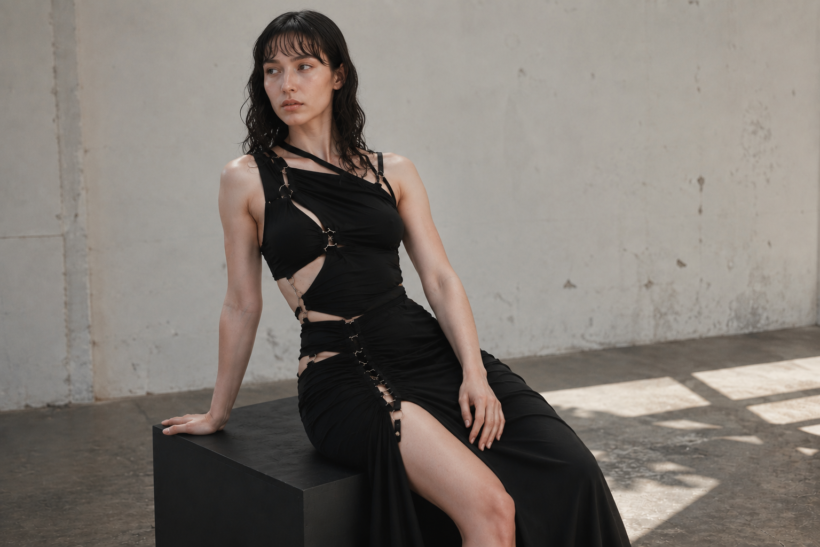
A body doesn’t simply become 10 percent larger in every direction.
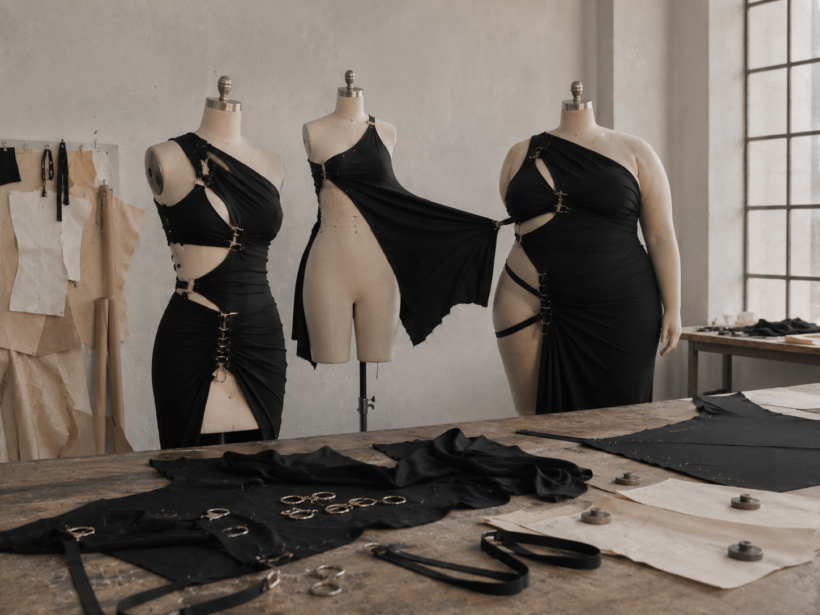
Busts change proportion. Stomachs change the way fabric falls. Thighs affect movement. Waists and hips don’t expand at identical rates.
Neither do shoulders, arms or backs.
Two people who technically wear the same size can have completely different relationships with the same garment.
That’s why Sinéad O’Dwyer’s work is more interesting than simply “size inclusive fashion.”
Her clothes frequently make the relationship between garment and body visible.
Stretch materials expand. Straps trace the body. Knitted structures adapt. Open constructions reveal rather than conceal.
The garment doesn’t pretend the body underneath it is irrelevant.
The body finishes the garment.
And suddenly, fit becomes part of the design rather than a judgment made after it.
Inclusivity isn’t just adding more sizes.
It’s changing the body you imagine while designing.
Why Do We Still Notice the Body First?
Put a model with fashion’s conventional proportions on a runway and nobody describes the casting as courageous.
She is simply a model wearing clothes.
Change the body and the vocabulary changes.
Inclusive. Body positive. Diverse. Groundbreaking. Brave.
The clothes haven’t even been discussed yet.
That tells us something.
Certain bodies have appeared in fashion so consistently that we’ve learned to see them as neutral.
Other bodies still arrive carrying a message.
A larger body can’t simply wear a dress. It becomes a statement about larger bodies wearing dresses.
A disabled model can become a story about representation before anyone discusses the construction of the garment.
Visibility matters.
But perhaps the real destination is something less dramatic.
Ordinariness.
The moment when different bodies can appear in fashion without their presence requiring an explanation.
O’Dwyer’s casting makes that possibility easier to imagine.
Not because everyone becomes the same.
Because nobody has to be treated as an exception.
The Runway Isn’t the Only Thing That Has to Change
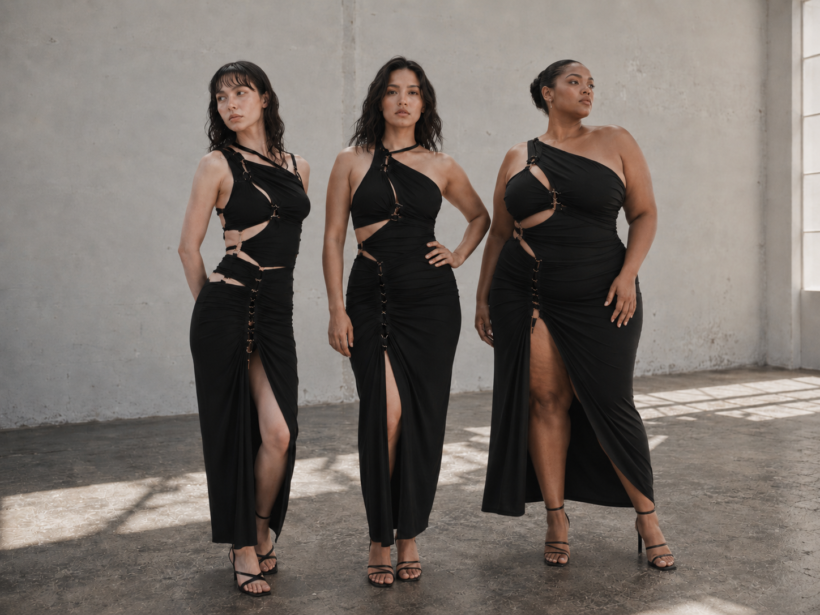
Representation is the part we can see.
Design is harder to photograph.
And access can be almost invisible.
That distinction matters with Sinéad O’Dwyer.
Her approach has extended beyond who appears in the clothes to questions around who can actually participate in the fashion experience.
That includes accessibility around presentations themselves.
Because putting a disabled model in a campaign while the physical fashion space remains difficult for disabled people to enter would expose an obvious contradiction.
The same applies to sizing.
Showing different bodies while producing clothes for only a narrow range of them turns inclusion into an image rather than a system.
Fashion has become extremely good at producing images of change.
The harder work is changing what happens behind them.
Patterns. Fittings. Production. Casting. Access. The clothes available after the runway show ends.
Representation changes the picture.
Design changes who the picture is for.
More Bodies Create Better Questions
There is another reason all of this matters.
Designing for more bodies doesn’t necessarily restrict creativity.
It can create more of it.
Start with roughly the same body every season and designers repeatedly solve variations of familiar problems.
Change the body and suddenly the questions multiply.
Where should this seam go?
How should this fabric stretch?
Where does support need to happen?
What happens when the wearer sits?
How does the garment open?
Can someone put it on without assistance?
How does it interact with a wheelchair?
What happens with a larger bust and a smaller waist?
How should a knit behave across different proportions?
These aren’t problems sitting outside fashion design.
They are fashion design.
And every new constraint creates another opportunity to invent.
This may be the most interesting way to understand what O’Dwyer’s work represents.
Not inclusion as an obligation.
Not diversity as a marketing layer.
But different bodies as new design information.
More bodies. More questions. More solutions.
Potentially, more interesting clothes.
The Clothes Should Feel Lucky to Have You
Go back to the fitting room.
The zipper stops. The waistband digs in. The shirt pulls somewhere it shouldn’t.
For years, fashion trained us to interpret that moment in one direction:
Something about me needs to change.
Lose weight. Hide this. Flatten that. Choose something more flattering. Maybe try the next size.
But imagine reversing the judgment.
The trousers don’t fit.
Why weren’t they designed for my proportions?
The shirt pulls.
Why wasn’t enough room considered here?
The garment fails.
Why am I the one apologizing?
It’s a tiny shift.
But it changes the power relationship between clothes and the person wearing them.
Fashion stops becoming a test the body has to pass.
The garment has to prove itself too.
From Taste to Body
This is where Sinéad O’Dwyer connects back to Part One of this BRANDDIP special.
Memory NYC asked us to think about personal taste.
About wardrobes built slowly through memories, places, accidents and objects we choose to keep.
About escaping the strange efficiency of an internet that can package an entire identity into an aesthetic and deliver it to us in seconds.
It returned fashion to a simple question:
Why do you like what you like?
But there’s a condition underneath that freedom.
You need to be able to wear it.
Personal style isn’t completely personal if fashion has already decided which bodies get the widest range of choices.
Memory approaches individuality through taste.
Sinéad O’Dwyer approaches it through the body.
Different starting points.
Same person at the center.
And together they reveal something important about where fashion may be moving next.
Not toward another universal aesthetic.
Toward fewer assumptions about the person wearing the clothes.
Maybe the Most Radical Body Is Just a Body
Fashion loves transformation.
Clothes make you taller. Thinner. Sharper. Softer. Sexier. Younger. More sophisticated.
There is almost always an implied version of the body that exists before the clothes—and a supposedly improved version afterward.
Sinéad O’Dwyer’s work leaves room for another possibility.
What if the body doesn’t arrive at fashion as a problem waiting to be solved?
A stomach can simply be a stomach.
A thigh can simply be a thigh.
A wheelchair can exist in a fashion image without becoming the entire meaning of the image.
A larger body doesn’t have to symbolize confidence.
A disabled body doesn’t have to symbolize courage.
They can wear something beautiful.
They can dislike it.
They can style it badly.
They can change their mind.
They can simply participate.
Maybe that’s when fashion becomes genuinely personal.
Not when everyone is given another identity to choose from.
But when more people are given the freedom to choose at all.
The person shouldn’t have to fit fashion.
Fashion should be capable of meeting the person.
BRANDDIP SPECIAL · FASHION GETS PERSONAL AGAIN
PART 01 · MEMORY NYC
From trend to taste.
PART 02 · SINÉAD O’DWYER
From size to body.
Two brands approaching fashion from completely different directions.
One asks us to reconsider what we choose.
The other asks us to reconsider who gets to choose.
And somewhere between taste and body, fashion begins to feel personal again.
WORDS · BRANDDIP
SPECIAL · FASHION GETS PERSONAL AGAIN
PART 02 · SINÉAD O’DWYER
LONDON