
Shark ChillPill: When Did Staying Cool Become Part of Getting Dressed?
A handheld fan used to be something you bought because the weather was unbearable. Then Shark ChillPill began appearing at fashion shows, festivals and summer events—looking less like emergency equipment and more like the final accessory of an outfit.
WORDS BY BRANDDIP · LONDON / PARIS / SUMMER 2026
 The summer accessory people kept reaching for was not a bag, watch or pair of sunglasses. It was something designed to make the heat more bearable.
At the Wimbledon men’s semifinals in July 2026, spectators arrived with the usual evidence of a British summer occasion.
Sunglasses.
Linen.
Hats.
Cold drinks.
And, increasingly, a compact device shaped like a smooth oversized capsule.
The same object had already appeared in the hands of fashionable Londoners and among guests navigating the heat around Paris Men’s Fashion Week.
It was the Shark ChillPill, a personal cooling system launched only a few months earlier.
At $149.99, it cost considerably more than the small plastic fans available from convenience stores and online marketplaces.
But people were not treating it like an ordinary handheld fan.
They carried it visibly.
Matched it with their clothes.
Attached straps.
Photographed it at festivals.
Placed it on restaurant tables.
What had previously been a slightly embarrassing admission—
I am too hot and need a machine to help me—
was becoming part of the outfit.
When did staying comfortable in public become something we were supposed to style?
The Heat Was No Longer Happening in the Background
Fashion has always responded to weather.
Coats make winter visible.
Sandals announce summer.
Umbrellas appear when the sky changes.
But extreme heat creates a different problem.
There are only so many layers you can remove.
Shade is not always available.
And in many European cities, air conditioning is less common than visitors from the United States or parts of Asia might expect.
For years, people managed this privately and imperfectly.
A folded programme became a fan.
A cold bottle moved across the neck.
A cheap plastic device appeared briefly, then disappeared into a bag.
The cooling tool was functional but visually apologetic.
It communicated discomfort, not taste.
That changed when the heat became too persistent to hide and the objects used to manage it became too visible to ignore.
During the severe European heat of June and July 2026, interest in handheld fans rose across the United Kingdom, France and Germany.
The category was no longer limited to commuters quietly enduring a warm train.
Fans appeared at sporting events, fashion gatherings, outdoor restaurants and music festivals—places where appearance and social visibility matter.
Once enough people began carrying them openly, the question was no longer:
Do I need a fan?
It became:
Which one am I willing to be seen carrying?
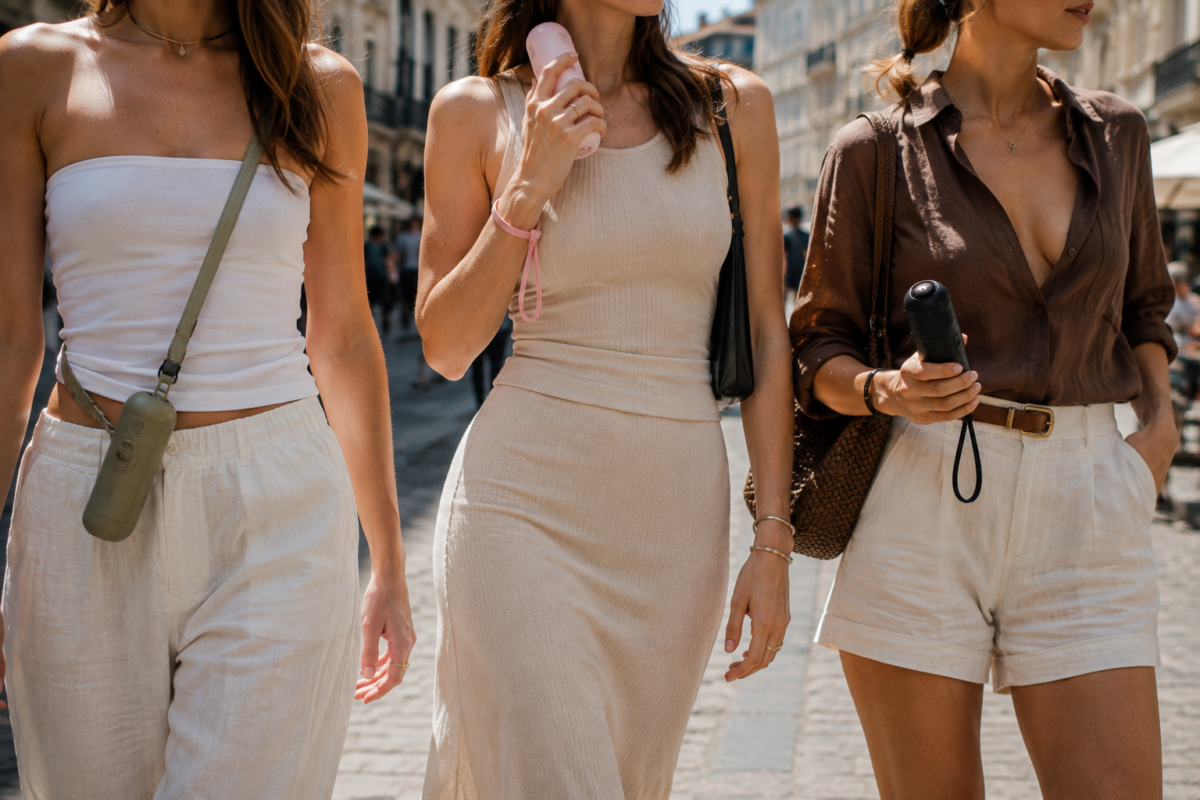 Once a cooling device stays visible for hours, its colour, shape and the way it is carried begin to matter.
A Cheap Category Suddenly Had a Premium Option
Handheld fans were not new.
That is precisely why Shark ChillPill became interesting.
The category already existed, but most products occupied the same cultural position as portable chargers, travel adaptors and emergency rain ponchos.
You bought one because you needed it.
You did not necessarily want anyone to ask about it.
Shark entered with a different proposition.
ChillPill combined a bladeless fan, an evaporative mister and a contact cooling plate in one modular device.
It came in colours with names such as Carbon, Iced Latte, Matcha and Dragon Fruit.
It could be carried in the hand, placed on a table or worn with optional straps and accessories.
Functionally, these choices expanded how the product could be used.
Culturally, they did something else.
They gave consumers more decisions to make.
Which colour belongs with me?
How will I carry it?
Which attachment will I use?
Does it stay in my bag, or does it remain visible?
This is often how an ordinary tool begins to behave like an accessory.
Not when it stops being functional.
When function becomes only one part of the purchase.
A category becomes fashionable when consumers begin choosing between versions of themselves—not merely versions of the product.
The Price Made the Object Easier to Notice
There is no shortage of inexpensive handheld fans.
Many are effective.
Some offer long battery life.
Others are smaller, lighter and far less expensive than ChillPill.
That makes the product’s visibility more revealing.
At $149.99, the purchase requires explanation.
You can describe the airflow.
The mist.
The cooling plate.
The modular attachments.
But price also gives an ordinary object social weight.
A person carrying a ten-dollar fan is solving a problem.
A person carrying a distinctive 150-dollar cooling device may also be communicating that they found a more considered solution.
This does not mean every owner is buying it for status.
Many consumers may simply value the combination of cooling functions.
But once a relatively expensive device becomes recognizable in public, ownership begins to acquire a second meaning whether the buyer intended it or not.
The object says:
I knew this existed.
I decided the cheaper version was not enough.
I prepared for the heat before arriving.
That is how necessity and status begin to overlap.
Wellness Escaped the Bathroom
Personal comfort used to be managed largely in private.
Skincare happened at the bathroom mirror.
Massage tools stayed at home.
Cooling masks remained in the refrigerator.
Even sweating was something to conceal rather than manage openly.
But wellness products have gradually moved into public view.
Large water bottles sit on desks.
Wearable health trackers stay on wrists.
Headphones create portable quiet.
Neck pillows, compression socks and eye masks appear in airport lounges.
Consumers have become increasingly comfortable carrying visible evidence that they are regulating their bodies.
ChillPill belongs to that change.
It does not pretend that the body is unaffected by the environment.
It makes personal temperature management visible, portable and adjustable.
The product promises more than airflow.
It promises the ability to create a small, controllable climate around yourself.
That promise is especially attractive when the larger environment feels increasingly uncontrollable.
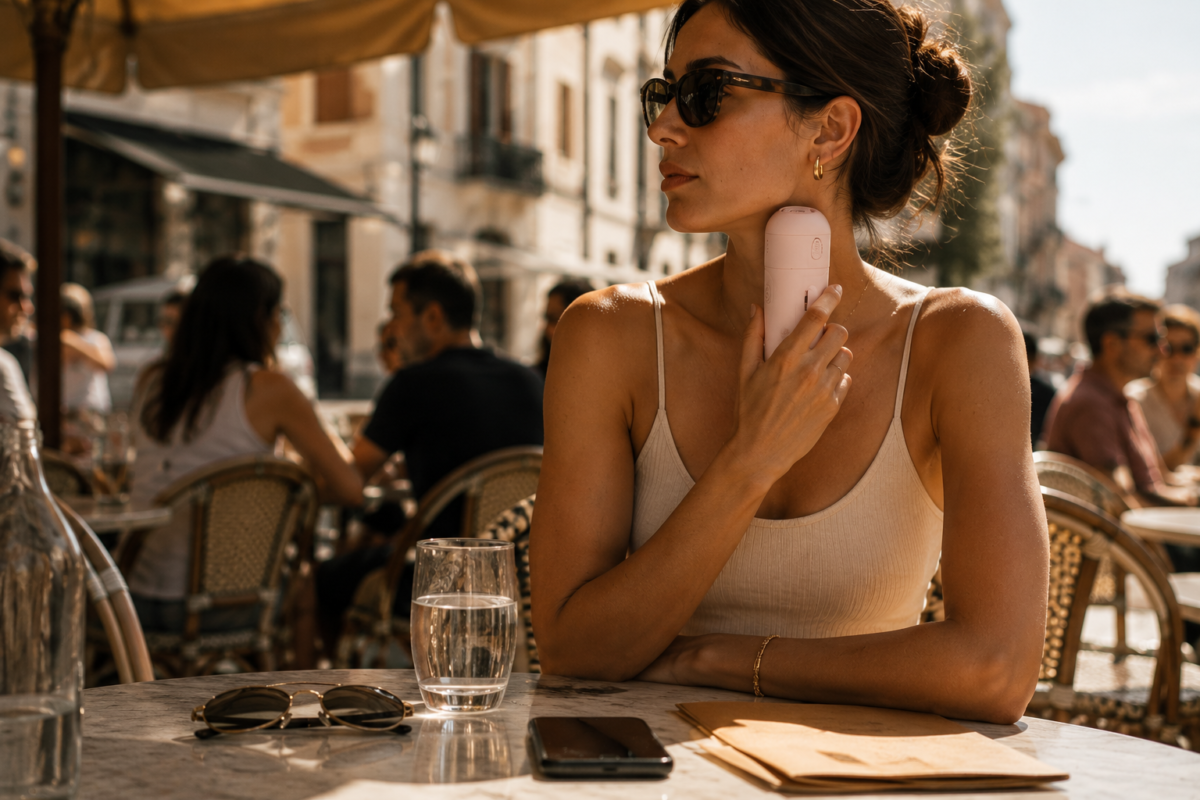 Personal cooling transforms a public environment without changing the environment itself.
The Product Was Designed to Travel Through Social Media
Many cooling devices look like small appliances.
ChillPill looks like it was designed to survive being photographed.
Its form is clean and immediately recognizable.
The colour range is easy to distinguish.
The interchangeable components create small demonstrations that work naturally in short videos.
Fan.
Mist.
Cooling plate.
Each function provides a visible moment of proof.
Influencers could hold the device beside an outfit, test it at a festival or press the cold plate against the skin.
The audience did not need a technical explanation before understanding the product.
It was hot.
The person looked relieved.
The device looked unusual.
The price generated debate.
That combination is ideal for social circulation.
Celebrity and influencer exposure helped accelerate the product’s visibility during its first summer.
But endorsement alone does not explain why people kept noticing it in public.
The more important feature may have been recognizability.
A generic fan disappears into the category.
ChillPill remains identifiable from a distance.
That makes every user a small part of the campaign, even when nobody is filming.
A Status Symbol Does Not Have to Be Useless
The phrase status symbol often suggests an object whose primary purpose is to display wealth.
But contemporary status objects are frequently practical.
A premium water bottle still holds water.
Expensive headphones still play music.
A carefully designed suitcase still carries clothes.
The function gives consumers a rational explanation.
The recognition creates the social layer.
ChillPill operates in the same space.
Its fan can move air.
The mister can offer evaporative cooling.
The contact plate can feel immediately cold against the skin.
Those functions are real.
They do not automatically make the product necessary, uniquely effective or worth the price for everyone.
Affordable competitors may offer a better answer for consumers who simply need portable airflow.
That tension is part of the story.
People were not choosing between having relief and having none.
They were choosing between an invisible solution and a culturally legible one.
The most effective status products solve a real problem—and make sure the solution can be recognized.
Europe Was the Perfect Stage
The ChillPill story would have looked different in a city where central air conditioning is expected everywhere.
In much of Europe, summer heat is experienced publicly.
On trains.
At outdoor tables.
Inside older buildings.
Across long event queues.
During sporting fixtures and fashion weeks where leaving early because of discomfort can mean missing the reason you came.
The heat created a practical need.
The social settings created visibility.
And the contrast between elegant environments and physical discomfort created an opening for a product that could address both.
That is why Wimbledon and Paris Fashion Week mattered symbolically.
These were not places where a fan could be dismissed as an eccentric travel gadget.
They were environments that influence what becomes culturally desirable.
Once the cooling device appeared there repeatedly, it gained permission to be seen differently elsewhere.
Not merely as equipment for people who could not handle the weather.
As evidence that the prepared person had understood the new summer dress code.
Climate Adaptation Is Becoming a Consumer Category
There is a larger and less playful reality behind the product’s rise.
Summers are becoming harder to treat as a temporary inconvenience.
Extreme heat changes commuting, travel, outdoor leisure, clothing and the way cities use public space.
Large solutions involve buildings, public infrastructure, energy systems and labour protections.
Consumer products cannot replace those things.
But when collective systems feel slow, people buy individual responses.
Portable fans.
Cooling towels.
UV-protective clothing.
Insulated bottles.
Wearable shade.
Personal cooling systems.
This is the uncomfortable contradiction inside ChillPill’s fashionable summer.
The object can feel playful.
The reason it became useful is not.
Its success suggests that adapting to heat is becoming an everyday purchasing decision rather than an occasional emergency response.
And once adaptation becomes routine, brands begin competing over what that adaptation should look like.
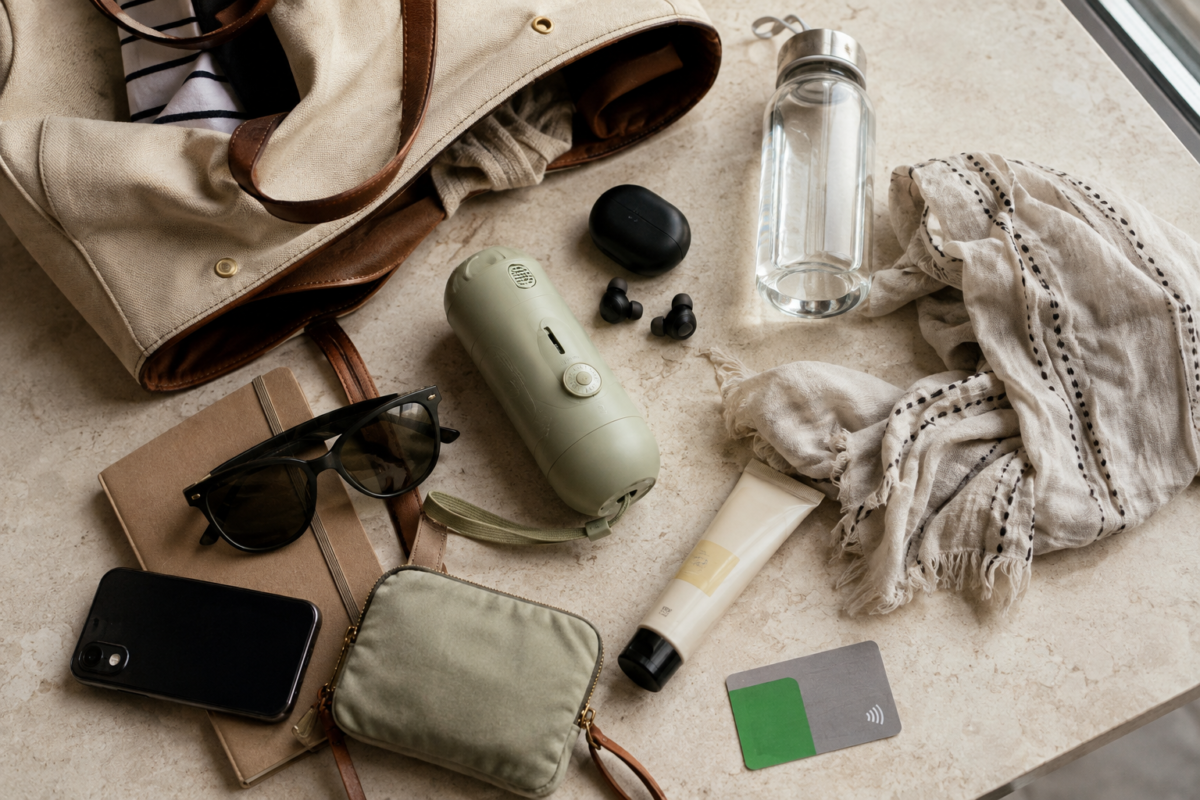 As extreme heat becomes routine, personal cooling begins to sit beside the objects people already carry every day.
What Happens When Everyone Has One?
The first summer of a new object is unusually powerful.
People ask what it is.
Owners demonstrate it.
Strangers notice the shape.
The device communicates discovery.
But visibility eventually changes the meaning of a product.
If personal cooling devices become common, carrying one will stop signalling novelty.
It may become as ordinary as carrying a bottle of water.
That would not necessarily mean the trend failed.
It might mean the category succeeded.
The harder question is whether ChillPill itself can remain culturally distinct once affordable alternatives copy the colour choices, straps and wearable format.
The first-mover advantage of being recognizable can disappear quickly.
And a 150-dollar price becomes more difficult to defend once the product is no longer the only version consumers desire.
There are already critics who argue that much cheaper handheld fans provide sufficient cooling and, in some cases, longer practical battery life.
That criticism matters.
BRANDDIP is not interested in declaring the most expensive solution the best one.
The interesting part is that consumers briefly treated the expensive solution as the most visible one.
Maybe Comfort Is the New Conspicuous Consumption
Traditional luxury asked other people to notice what you could afford.
Contemporary premium products often ask them to notice how well you have optimized your life.
Your water is colder.
Your luggage moves more smoothly.
Your sleep is tracked.
Your workspace is quieter.
Your body remains comfortable even when the environment does not cooperate.
This is a subtler form of display.
It is not simply:
I own something expensive.
It is:
I have found a better way to move through the world.
ChillPill arrived at exactly the right intersection.
The climate created the need.
Design made the device publicly acceptable.
Price made it discussable.
Fashionable settings made it desirable.
Social media made the explanation travel.
For one unusually hot European summer, a handheld fan stopped looking like an admission of defeat.
It looked like preparation.
Maybe even taste.
BRANDDIP TAKE
Shark ChillPill became interesting not because it invented personal cooling, but because it arrived when managing the heat was becoming visible—and gave that visibility a shape people were willing to wear.
DISCOVER SHARK CHILLPILL
Explore the cooling modes, available colours and accessories through Shark’s official product website.
WORDS · BRANDDIP
CATEGORY · TASTE OF BRAND
EUROPE / SUMMER 2026